
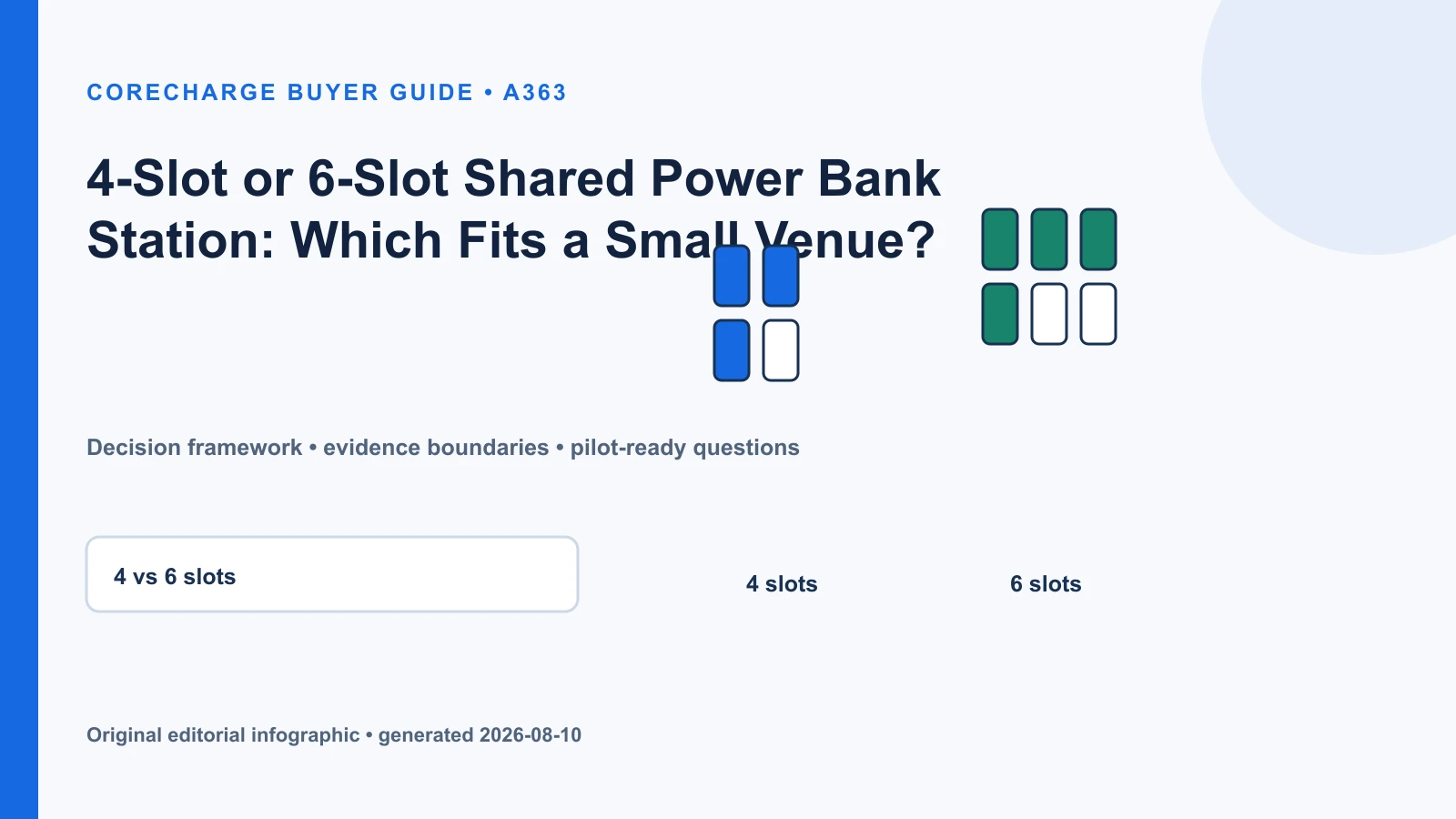
Answer first: choose four slots when the venue is genuinely low-volume, counter space is tight, and staff or a field operator can replenish quickly. Choose six slots when demand is still modest but the site needs more protection against a short rush, delayed restocking, or several returns arriving together. Do not select by footprint alone. The better choice is the smallest station that can hold enough rentable power banks and enough empty return slots through the venue’s busiest interval.
A four-slot station is useful because it lowers the commitment of a first placement. It can fit a compact counter, make a product demonstration easier, and test whether customers will notice, scan, pay, borrow, and return in that location. But four physical slots do not mean four guaranteed rentals. One slot may need to remain empty for returns, one power bank may be charging or unavailable, and another may be tied up in a long rental. A station that looks economical on a purchase list can therefore become unavailable after only a few transactions.
A six-slot station adds only two positions, yet those positions can change the operating margin. They can provide one more rentable unit and one more return opportunity, or absorb a short burst before a restocking visit. That does not make six slots universally better. If the station is hidden behind a till, blocks staff work, creates cable clutter, or narrows a public route, the extra capacity may reduce visibility and venue acceptance. U.S. accessibility standards define an accessible path of travel as continuous and unobstructed, while OSHA rules protect exit-route width from projecting objects [1][2]. These are U.S. references, not universal placement approvals, but they illustrate why capacity cannot be separated from safe physical placement.
Start with a two-sided capacity test
Every docked rental station serves two flows: departures and returns. Ask two separate questions:
1. How many power banks must be ready before the next service visit? 2. How many slots must remain available so a customer can return without calling support?
The General Bikeshare Feed Specification provides a useful operational analogy. Its real-time station model separates vehicles available from docks available rather than treating station capacity as one number [3]. Shared power banks are a different product, but the inventory principle transfers cleanly: availability to borrow and capacity to return should be monitored independently.
For a four-slot pilot, a practical starting configuration might be two or three rentable units and one or two return positions. For a six-slot pilot, the operator may start with three or four rentable units and preserve two return positions. These are not industry standards or performance guarantees. They are hypotheses to test against actual transaction timestamps, unsuccessful return attempts, device charging status, and the time between service visits.
When four slots is the stronger choice
Choose four slots when all of the following are substantially true:
- The venue has low or uncertain demand and the purpose is discovery, not peak coverage.
- Counter depth, power access, and staff workspace have been measured.
- The station can sit in the natural customer path without obstructing an accessible route or exit.
- Replenishment can happen quickly if inventory falls below the agreed threshold.
- Nearby stations provide an alternative return point, or the pilot clearly explains the return policy.
Four slots are especially defensible for a controlled sample deployment. The operator learns whether the problem is awareness, payment conversion, available inventory, or return convenience before buying more capacity. If rentals remain low even when the station is visible, online, stocked, and easy to pay for, moving directly to a larger cabinet will not solve the underlying issue.
When six slots earns the extra space
Choose six slots when the venue experiences compact rushes, such as lunch, an evening service window, appointment turnover, or closing time. Six slots also make sense when field service is less frequent, cross-station returns are enabled, or support calls caused by a full station would be expensive. The additional capacity should have a named purpose: borrow buffer, return buffer, charging buffer, or maintenance buffer.
Do not use average daily rentals as the only sizing input. Four rentals spread across ten hours are different from four rentals within twenty minutes. Review the busiest 15- or 30-minute intervals, the lowest ready-to-rent inventory, the lowest empty-slot count, and the time required to restore the station. If the four-slot station repeatedly reaches zero rentable units or zero return positions before service arrives, the evidence supports a six-slot upgrade or a second nearby station.
Visibility can outweigh two extra slots
The best station is not always the largest one a venue can physically accept. A compact station at the order queue, host desk, reception handoff, or waiting zone may outperform a larger unit placed out of sight. Confirm that the screen, QR entry, price disclosure, return instructions, and support route are readable without customers entering staff-only space. At the same time, avoid door swings, food preparation zones, wet areas, stairs, emergency equipment, and narrow circulation points.
Before approval, photograph the proposed location from the customer’s approach, record the available footprint and outlet, and ask the venue manager who may move or disconnect the station. A placement that depends on one employee remembering special instructions is fragile. The location should remain visible and operable across shifts.
Make the upgrade rule explicit
Define the decision before the pilot begins. For example, review after four full operating weeks and include representative weekdays and weekends. Consider an upgrade if the station repeatedly records no rentable power banks, no return slots, or service interventions caused by capacity rather than device faults. Keep the four-slot unit if availability remains healthy and the venue values its compact footprint. Relocate it if demand is weak despite good visibility and a functioning rental flow.
This approach turns 4-slot versus 6-slot from a catalogue preference into an auditable operating decision. The buyer is not purchasing two additional holes in a cabinet. The buyer is purchasing more time before stockout, more tolerance for returns, and potentially fewer emergency visits, provided the placement remains safe, visible, and accepted by the venue.
Evidence date and limits
Evidence reviewed through 2026-08-09. The following limits are part of this buyer guide:
- No cited source prescribes four or six slots for shared power bank venues; the recommendations are testable operating heuristics.
- Accessibility and exit-route sources cited here are U.S. references and do not establish approval in another jurisdiction.
- Demand, electrical, fire, accessibility, advertising, payment, privacy, and venue rules must be verified for the target country and property before publication or deployment. Verify target-country requirements before publication and deployment.
- No customer outcome, certification, utilization rate, ROI, or revenue result is claimed.
Related CoreCharge guides
- products 4 slot.html
- products 6 slot.html
- venue deployment checklist rental charging stations
- shared power bank business starter guide
- Previous guide in this capacity cluster
- Next guide in this capacity cluster
Sources
1. U.S. Department of Justice – 2010 ADA Standards for Accessible Design (accessed 2026-08-09). accessible paths of travel are continuous and unobstructed; walking-surface clear-width requirements illustrate why equipment placement must preserve circulation. It does not certify a station or govern every country. 2. U.S. Occupational Safety and Health Administration – 29 CFR 1910.36 – Design and construction requirements for exit routes (accessed 2026-08-09). objects must not reduce exit-route width below applicable minimums and exit capacity must remain adequate. 3. MobilityData – General Bikeshare Feed Specification (GBFS) (accessed 2026-08-09). real-time shared-mobility station status distinguishes available rental inventory from available docks, an operational analogy for tracking borrow and return capacity separately.
FAQ
Is a 4-slot station enough for a restaurant?
It can be enough for a low-volume pilot if the station remains visible, retains return space, and can be replenished quickly. Validate it with peak-interval data rather than daily averages.
Does a 6-slot station always produce more rentals?
No. Capacity cannot fix poor visibility, payment failure, weak demand, or an inconvenient return network.
How many slots should be left empty for returns?
There is no universal ratio. Start with at least one protected return position in a four-slot test and consider more where cross-station returns or bursty demand are common, then adjust from data.
When should a 4-slot station be upgraded?
Upgrade when repeated peak intervals reach zero rentable units or zero return positions and the cause is capacity rather than faults, connectivity, or poor servicing.