
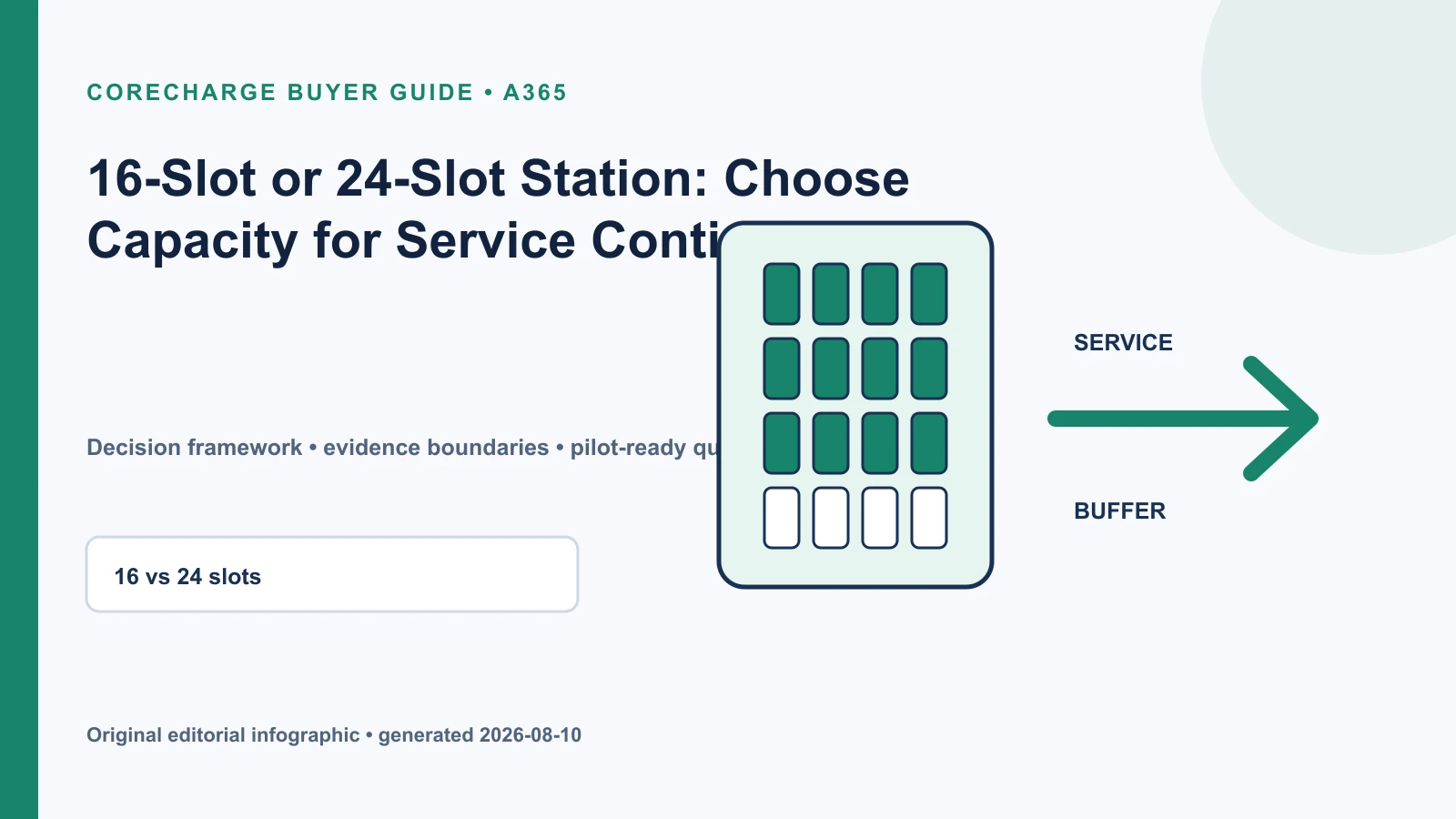
Answer first: choose 16 slots when a high-demand zone has reliable servicing, distributed nearby return points, and a measured peak that fits within a moderate borrow-and-return buffer. Choose 24 slots when the venue must absorb larger arrival or departure waves, field response is slower, cross-station returns are less predictable, or a temporary stockout would create significant support pressure. The larger cabinet is justified by service continuity, not by foot traffic alone.
Large venues are often described with one number: annual visitors, beds, tickets, passengers, or members. That number is too broad for station sizing. A transport concourse can be quiet most of the day and surge after a train. A hospital entrance can have continuous flow but strict circulation and facilities constraints. An event venue may generate a sharp borrowing wave before the program and an equally sharp return wave after it. A 16-slot or 24-slot decision must therefore use the local service zone and its peak interval, not the property’s total audience.
Capacity planning also needs more than physical slots. FTA guidance separates theoretical maximum capacity from design capacity, operated capacity, and demand [1]. Applied carefully as an analogy, a 24-slot cabinet’s physical maximum is not its usable service capacity. The operating plan may reserve several empty positions for returns, hold charging units, isolate a faulty bay, or preload inventory for a known peak. The buyer should ask how many ready units and working return positions remain under realistic conditions.
Choose the service promise first
Define what failure means at this venue. Is the objective to avoid any empty period during staffed hours? To keep at least three return positions available? To recover within thirty minutes after an alert? To maintain service through a train arrival or event interval without a field visit? Without an explicit service objective, a 24-slot station can appear safer while masking weak monitoring and slow response.
Then model two stress cases:
1. A borrowing wave reduces ready inventory faster than returns replenish it. 2. A return wave consumes empty slots faster than new rentals release them.
Docked shared-mobility research repeatedly identifies empty and full stations as opposite service failures and finds that transit-adjacent stations receive disproportionate rebalancing, often around morning and afternoon capacity pressure [2]. Shared power banks have different hardware and demand patterns, so the finding is not a direct forecast. It does support planning for directionally uneven flows at transport and event-linked sites.
When 16 slots is operationally sufficient
A 16-slot class is defensible where demand is meaningful but manageable and the surrounding network shares the load. Examples include a hospital public lobby with additional stations in outpatient or food areas, a hotel with another return point near conferences, or a mall zone served by several nearby cabinets. Sixteen slots can also be appropriate when staff or field teams can replenish predictably and the SaaS produces timely low-inventory and low-empty-slot alerts.
Use a 16-slot station when adding capacity would mostly increase idle stock rather than reduce failed service. Review the lowest ready count and empty-slot count during peak intervals, the frequency of alerts, and recovery time. If the station maintains the agreed buffer through representative peaks, a larger cabinet may not be necessary. A second 16-slot location can sometimes improve visibility and return convenience more than concentrating 24 slots at one entrance, although it adds power, connectivity, maintenance, and venue-coordination overhead.
When 24 slots provides real resilience
A 24-slot station is justified when four conditions converge: a substantial peak, uncertain flow direction, longer intervention time, and a high cost of user failure. Examples include a transport interchange after scheduled arrivals, a convention break, an arena exit, or a facility where customer support cannot easily redirect a user to another return point.
The additional eight positions should be allocated in an operating plan. Before a borrowing wave, more can hold ready units. Before an expected return wave, more should remain empty. If the system allows cross-location returns, forecasts should include inbound rentals from other stations. If several bays are unavailable or charging is slow, the nominal capacity should be discounted. The SaaS view should show these states separately; a simple “18 of 24 occupied” indicator is not enough.
Do not trade circulation for capacity
Large cabinets require more rigorous placement approval. The ADA Standards define accessible routes and minimum clear-width requirements in covered U.S. facilities [3]. Event guidance from the UK Health and Safety Executive likewise stresses clear pedestrian routes, entrances, exits, circulation, and crowd monitoring [4]. These sources do not provide global permission or a cabinet-specific layout. They establish a conservative principle: never solve inventory capacity by creating a circulation, accessibility, queue, or emergency-access problem.
At a large venue, obtain a marked floor plan, power approval, network assessment, cleaning responsibility, security review, and an agreed no-move zone. Check sight lines from the natural approach, but avoid pinch points, security screening, door swings, clinical circulation, baggage queues, and emergency equipment. A large station placed beside a famous entrance may be commercially visible and operationally unacceptable.
Run a peak rehearsal before committing
Before scaling, simulate the expected wave with a representative station and production-like SaaS configuration. Verify concurrent scans, payment callbacks, dispense acknowledgements, return recognition, slot state changes, alerts, and the field team’s response. Record events with local time and time-zone offsets. Include failures: one offline bay, delayed network messages, a returned unit still marked unavailable, and a customer attempting to return at a nearly full cabinet.
After launch, review completed rentals together with unmet demand signals. A station that completes many orders may still fail at the exact peak. Conversely, low average occupancy may be intentional if empty slots are protecting a return wave. Capacity should be evaluated against the service promise, not optimized for visual fullness.
The result is a more disciplined choice. Sixteen slots can be the right high-traffic station when the network and response process are strong. Twenty-four slots can be the right resilience tool when the venue produces sharp, consequential waves. Neither number is a universal category, and neither substitutes for return capacity, telemetry, placement approval, or field operations.
Evidence date and limits
Evidence reviewed through 2026-08-09. The following limits are part of this buyer guide:
- No official source in this article mandates 16 or 24 slots for any venue; both are procurement classes to validate locally.
- Transit and bike-sharing sources are analogies for capacity and directional inventory, not shared-power-bank demand forecasts.
- U.S. and UK safety/accessibility references do not establish compliance elsewhere. Verify target-country requirements before publication and deployment. all venue, electrical, fire, accessibility, payment, privacy, import, and product requirements.
- No customer, brand endorsement, certification, throughput, ROI, or revenue result is asserted.
Related CoreCharge guides
- products 24 slot.html
- products 12 slot.html
- choose shared power bank stations from china
- shared power bank rental software integration checklist
- Previous guide in this capacity cluster
- Next guide in this capacity cluster
Sources
1. U.S. Federal Transit Administration – Characteristics of Bus Rapid Transit for Decision-Making (accessed 2026-08-09). maximum, design, operated capacity, and actual demand are distinct concepts; used as a planning analogy only. 2. Cyrille Medard de Chardon, Geoffrey Caruso, and Isabelle Thomas – Bike-share rebalancing strategies, patterns, and purpose (accessed 2026-08-09). empty/full station states drive rebalancing; transit-adjacent stations receive disproportionate rebalancing and time-of-day capacity pressure matters. 3. U.S. Department of Justice – 2010 ADA Standards for Accessible Design (accessed 2026-08-09). accessible routes are continuous and unobstructed and have applicable clear-width requirements. 4. UK Health and Safety Executive – Put crowd controls in place (accessed 2026-08-09). event planning should address entry, circulation, exit, clear pedestrian routes, queues, and crowd monitoring.
FAQ
Does a transit hub automatically need 24 slots?
No. Size the specific zone using peak-direction flow, nearby stations, return behavior, and recovery time. Total passenger volume is not enough.
Is one 24-slot station better than two 16-slot stations?
Not always. Two locations may improve visibility and return access, while one larger station may be easier to power and service. Compare both as network designs.
How should a 24-slot station be loaded before an event?
Use the expected direction of flow. Protect ready inventory before a borrowing wave and empty slots before a return wave, while discounting charging or unavailable bays.
What should be tested in a peak rehearsal?
Test scanning, payment, dispensing, returns, slot-state telemetry, alerts, concurrent use, network delay, unavailable bays, and field response.